
For most of its history, project portfolio management has been judged by the quality of its front door. Proposals arrive, are scored against strategic criteria, ranked, and approved or declined in an annual planning round. A portfolio office runs the process; once the list is agreed, attention moves to the projects themselves. The model met a real need. Organisations had more ideas than money, and they needed a defensible way to choose.
The question now facing portfolio leaders is whether choosing well is enough. Our answer is that it is not. Selection remains necessary, but much of the value a portfolio creates or destroys is decided after approval: in whether the organisation has the capacity to deliver what it approved, how funding is released as evidence accumulates, where risk concentrates across projects, how confidence in delivery shifts from quarter to quarter, and whether the promised benefits are ever realised. Project portfolio management (PPM) is becoming the continuous stewardship of that whole sequence.
The shift is visible in the professional standards, in how governments run their largest portfolios, and in research on projects that are delivered yet fall short of their purpose. It changes what the PMO does, what executives should ask for and what counts as a well-run portfolio.
In brief
- Project portfolio management is, in APM’s definition, the selection, prioritisation and control of an organisation’s programmes and projects, in line with its strategic objectives and capacity to deliver. Selection is only the first of those tasks.
- The case for an end-to-end view rests on evidence that value is lost after approval. In PMI’s 2026 research, about a third of complex projects failed to achieve the full scope of their originally intended benefits.
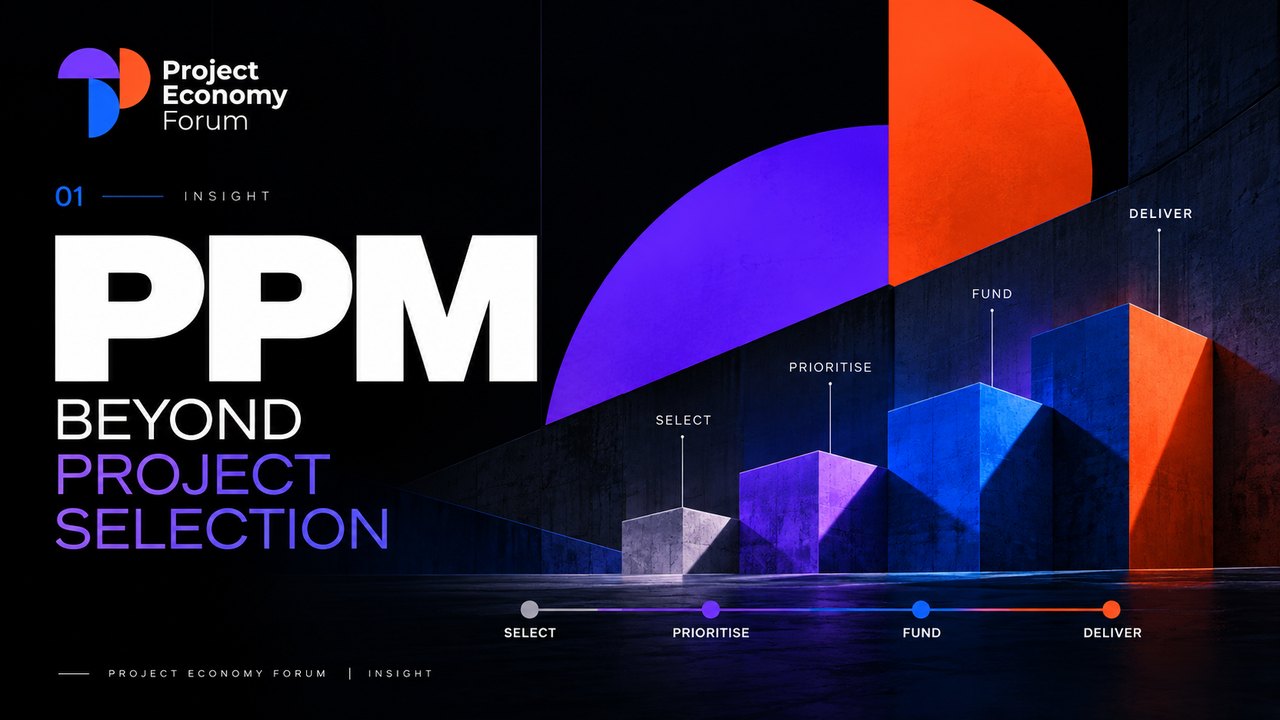
- A modern portfolio is governed through five linked decisions: select, prioritise, fund, deliver and realise value. Each needs its own evidence and has its own failure modes.
- Capacity, risk concentration and delivery confidence are portfolio-level signals, not project-level detail. The UK’s Government Major Projects Portfolio shows how one confidence scale can be applied across 189 projects.
- The PMO’s role moves from reporting on projects to supporting decisions about the portfolio, including the decision to stop.
What portfolio management was built to do
The professional definitions have always been broader than common practice. APM’s definition, taken from the 2025 edition of its Body of Knowledge, puts selection alongside prioritisation and control, and ties all three to the organisation’s capacity to deliver. PMI’s Standard for Portfolio Management (third edition, 2013) describes portfolio management as centralised management that lets executives meet organisational goals through efficient decisions about portfolios, projects, programmes and operations. It also makes a point that is easy to overlook: unlike a project or programme, which has a scheduled start and end, portfolio management is a continuous process.
In practice, many organisations installed the first part and not the rest. Intake forms, scoring models and ranked lists are relatively easy to introduce. The same PMI standard observed that, at a basic level, a PMO may handle communication in the form of status reporting. In our reading, that describes where many portfolio offices began: a front door for new proposals and a reporting line for approved ones, with the decisions in between made somewhere else.
The front-door model had its logic. Budgets are set annually, so selection was annual. Scoring gave executives a transparent rationale for difficult choices. Delivery sat with project and programme managers. Its weakness is that it treats the portfolio as a list approved once rather than as an investment position that changes every month.
Why selection alone no longer holds
Three developments have exposed the limits of the front-door model.
Success is measured by outcomes, not approvals
PMI’s Maximizing Project Success research defines successful projects as those that deliver value worth the effort and expense, a definition restated in PMI’s Pulse of the Profession 2026. Once success is defined that way, a selection decision is only a forecast of value. The 2026 survey, of 2,023 project professionals and 511 senior leaders across 35 countries, found that about a third (31%) of complex projects fail to achieve the full scope of their originally intended benefits, and that 61% of project professionals on complex projects report some form of value loss as a result of complexity (PMI, Pulse of the Profession 2026).
Conditions move faster than planning cycles
In the same survey, 81% of project professionals said projects have become more complex in recent years. A portfolio ranked in January against one set of assumptions can be misaligned by June. PMI’s standard anticipated this: a significant change in strategic direction requires the portfolio to be rebalanced, and components may be terminated before delivery with new ones approved in their place.
Portfolios are larger and more concentrated
The UK’s Government Major Projects Portfolio (GMPP) illustrates the scale. Its 2025–26 portfolio comprised 189 projects with a total whole-life cost of £924.2 billion and £603.6 billion of monetised benefits, delivered by 20 departments and their arm’s-length bodies (NISTA, Major Projects Annual Report 2025–26). Three projects designated as mega-projects, Sizewell C, HS2 and Dreadnought, together account for more than 10% of the portfolio’s whole-life cost. At that scale and concentration, the question shifts from “which projects?” to “how is the whole position performing, and where is it exposed?”
The end-to-end portfolio: five decisions, not one
The practical alternative to the front-door model is to treat the portfolio as a sequence of linked decisions, each revisited as evidence arrives. The framework below is our synthesis of the standards and evidence discussed in this brief.
| Decision | The portfolio question | Evidence that matters | Common failure |
|---|---|---|---|
| Select | Should this enter the portfolio at all? | Strategic fit, options considered, a credible business case | Approving anything that can be linked to strategy |
| Prioritise | What goes first, given everything else? | Relative value, urgency, dependencies, risk | Ranking once a year and never again |
| Fund | How much is released now, and on what evidence? | Maturity, cost to the next decision point, delivery confidence | Committing the whole lifecycle on day one |
| Deliver | Is the portfolio still likely to deliver what was promised? | Delivery confidence, capacity use, emerging risk | Reporting project status without portfolio consequences |
| Realise value | Did the investment produce the benefits that justified it? | Benefits tracked after handover against the original case | Closing projects before benefits are measured |
Prioritisation and strategic alignment
Alignment is a threshold, not a ranking. Almost any proposal can be connected to a broad strategy, which is why alignment scores rarely discriminate between good and weak investments. The UK National Audit Office gives a clear example. The UK Space Agency received £1.75 billion over 2022 to 2025 and allocated it through a prioritisation process that took account of the government’s space strategy. It nonetheless found it hard to de-prioritise anything, given the strategy’s breadth, and a joint lessons-learned exercise with its parent department found staff who felt that breadth was being used as a hook to justify individual programmes (NAO, Lessons learned: a planning and spending framework, 2024).
The lesson for portfolio leaders is that prioritisation has to be relative. Initiatives must be ranked against each other on value, urgency, risk and dependency, and the ranking must be repeated whenever conditions or capacity change.
Capacity: the constraint that makes a portfolio real
APM’s definition includes the organisation’s capacity to deliver for a reason. The UK’s project delivery standard, GovS 002, asks portfolio leaders to optimise the organisation’s capability and capacity so that the portfolio can be delivered, and to ensure that those affected by the portfolio’s outcomes can take on the changes (Cabinet Office, Government Functional Standard GovS 002: Project delivery, 2025). Capacity is more than headcount. It includes scarce specialists, supplier and contractor capacity, leadership attention and the business’s ability to absorb change.
Robert Cooper, creator of the Stage-Gate process for new-product development, describes the “hollow” go decision: a project is approved but resources are not committed, which usually leads to too many projects in the pipeline and projects taking far longer than they should (Cooper, Journal of Product Innovation Management, 2008). The remedy is simple to state and hard to practise: no approval without a capacity check, and a capacity model maintained as a portfolio asset rather than rebuilt for each planning round.
Funding: releasing capital as confidence grows
GovS 002 describes portfolio management as the practices and decisions that balance organisational change and business as usual within a specified funding envelope. How that envelope is released matters as much as its size. In its 2025 lessons on mega-projects, the NAO recommended stronger approval processes for the largest projects, which might include only providing funding to take a project to its next stage of development and maturity. Staged release turns funding into a portfolio control: every tranche becomes a decision, informed by what has been learned since the last one. The mechanics of investment committees, gates and funding models are covered in our brief on connecting capital to project outcomes.
Balance and risk: a portfolio is not a list
PMI’s standard defines portfolio balancing as optimising the mix of components to further the organisation’s strategic objectives, and to maximise return within its desired risk profile. GovS 002 asks for a portfolio balanced between short-term and long-term objectives, with risks kept within the organisation’s risk appetite.
Two features of project risk make balancing harder than it looks. The first is correlation: projects that share suppliers, specialist skills, technology platforms or a regulator can fail together. The second is the shape of outcomes. Flyvbjerg and colleagues analysed 5,392 IT projects and found that cost overruns follow a power-law distribution: many projects with relatively small overruns and a fat tail of projects with extreme ones. Managers who assume a normal distribution, they conclude, will grossly underestimate how often extreme overruns occur (Journal of Management Information Systems, 2022). For a portfolio, contingency and exposure calculated from averages will understate the downside, and one tail event can consume the headroom of the whole portfolio. That makes the quality of decisions taken before approval, examined in our brief on why capital projects fail before construction begins, a portfolio concern and not only a project one.
Expected value and delivery confidence
A business case states the value a project will create if it delivers as planned. A portfolio should also care about expected value: the benefits still achievable, weighted by the likelihood and timing of delivery, net of the cost still to be spent. Two projects with the same headline return are not equivalent if one is on track and the other is in serious difficulty. Expected value is our framing rather than a formal standard, but it depends on something portfolios can measure: delivery confidence.
NISTA defines a Delivery Confidence Assessment as an assessment of the likelihood of a project delivering its objectives to time and cost, rated Red, Amber or Green. At the end of March 2026, 29 GMPP projects were rated Green (15%), 109 Amber (58%) and 34 Red (18%), with 17 exempt (9%). Amber means delivery appears feasible but significant issues exist that require management attention. NISTA is explicit that a red rating does not mean a project will fail; it is a snapshot of risk if nothing changes.
Several design features are worth copying outside government. One scale is applied to every project in the portfolio. Ratings are refreshed quarterly. Where NISTA has supported or independently assured a project in the previous six months, its independent rating replaces the self-reported one. And NISTA has introduced an Early Warning System that uses existing portfolio data to flag projects at risk of moving to Red.
Value realisation: where portfolios go quiet
GovS 002 asks portfolio leaders to maximise the benefits realised by the portfolio as a whole. That is harder than it sounds. Of the GMPP’s 38 military capability projects, with a combined whole-life cost of £305.1 billion, only one reported benefits in the 2025–26 data, which NISTA attributes to the inherent complexity of monetising national security benefits. In line with NAO recommendations, NISTA has committed to ensuring that every project leaving the GMPP has had an exit review that considers how benefits will continue to be tracked.
PMI describes the corresponding failure in plain terms: projects that deliver outputs while losing sight of outcomes. The portfolio-level implication is that the benefits case must survive handover, with a named owner and a measurement plan that runs beyond project closure. What happens after completion is examined in our brief on turning projects into productive assets.
What changes for the PMO and the executive team
For the PMO, the change is from reporting to decision support. PMI’s standard already lists responsibilities for a portfolio management office that go well beyond status reports, including forecasting supply and demand across the portfolio and recommending the selection, termination or initiation of work to keep the portfolio aligned with strategy. In our reading, the portfolio office of the next decade owns the integrated view that executives lack: capacity against demand, confidence across projects, and benefits against the original case.
For executives, the change is from approving projects to governing a position. NISTA notes that HM Revenue and Customs has a well-developed central portfolio approach to govern major project investments, actively manage resources and adjust delivery priorities as circumstances change. At national level, NISTA refocused the GMPP from April 2026 to approximately 80 projects, with other major projects managed through departmental portfolios. That is a portfolio-of-portfolios design: central attention concentrated where significance and risk are highest, with clear accountability everywhere else.
In practical terms, senior executives can:
- Put the portfolio on the executive agenda at a fixed cadence, at least quarterly, for decisions rather than updates.
- Require a capacity check before any approval, covering people, suppliers and the business’s ability to absorb change.
- Release funding in stages tied to evidence, not in a single commitment at the start.
- Use one delivery confidence scale across capital, technology, transformation and R&D work, with independent challenge for the largest items.
- Track benefits after handover, with a named owner and a date on which the original case is tested.
- Treat stopping, pausing and reshaping as legitimate outcomes of every review.
How the end-to-end view connects the disciplines
Portfolio leadership is where the other disciplines meet. In asset-intensive organisations, capital projects are usually the largest items in the portfolio, so their front-end quality and delivery performance decide whether the portfolio delivers at all. Technology and transformation programmes tend to be shorter, but their benefits depend on adoption inside the business, which makes the capacity to absorb change a portfolio constraint (explored further through transformation and technology investment). R&D portfolios work differently again: attrition is expected, so disciplined gates and the willingness to end projects are part of the design.
Funding and governance supply the staged release of capital; delivery and risk supply the confidence signal and the controls behind it; results and value supply the proof. The end-to-end portfolio joins them, so that a decision taken in one discipline is visible in the others.
From first decision to final proof
The project economy can be described as a sequence: Decide, Fund, Deliver, Prove. Traditional PPM lived almost entirely in Decide. The end-to-end portfolio spans all four stages, and its most important connection runs backwards: evidence from Prove should inform the next Decide. This is the lens Project Economy Forum applies across its eight areas, of which portfolio leadership is one; its approach to the discipline is set out on its page for project portfolio management leaders.
Selection that learns
Moving beyond selection does not mean abandoning it. It means giving selection something to learn from. When delivery confidence, actual capacity use and realised benefits flow back into the portfolio, the next round of choices can be tested against what the organisation actually delivered rather than what it forecast. A portfolio that never measures value cannot tell whether its selection criteria work; a portfolio that does can recalibrate its estimates, its risk assumptions and its appetite for ambition.
That feedback loop also makes a harder question unavoidable. If the evidence says a project will no longer deliver value worth its remaining cost, the end-to-end portfolio has to act on it. Deciding what to stop, pause or defer is the subject of our companion brief on the discipline of stopping projects.
Frequently asked questions
What is project portfolio management (PPM)?
Project portfolio management is the selection, prioritisation and control of an organisation’s projects and programmes in line with its strategic objectives and its capacity to deliver. In its modern form it also covers how funding is released, how delivery confidence is tracked across the portfolio and whether promised benefits are realised.
How is portfolio management different from project management?
Project and programme management deliver defined pieces of work, each with a start and an end. Portfolio management is continuous: it decides which work the organisation should do, in what order and with what resources, and it keeps revisiting those decisions as conditions change.
What does a PMO do in portfolio management?
A portfolio office traditionally ran intake and status reporting. Its growing role is decision support: forecasting capacity against demand, maintaining a common view of delivery confidence and benefits, and recommending which work to start, continue, change or stop.
What is a delivery confidence assessment?
In the UK government’s definition, it is an assessment of the likelihood of a project delivering its objectives to time and cost, rated Red, Amber or Green. Applied consistently across a portfolio, it lets leaders compare risk between very different projects.
Sources
- Association for Project Management, What is portfolio management? (definition from the APM Body of Knowledge, 8th edition, 2025). APM
- Project Management Institute, The Standard for Portfolio Management, third edition (2013). PMI
- Project Management Institute, Pulse of the Profession 2026: Driving Success in Complex Projects (2026). PMI
- National Infrastructure and Service Transformation Authority, NISTA Major Projects Annual Report 2025–26 (2026). GOV.UK
- Cabinet Office and Government Project Delivery, Government Functional Standard GovS 002: Project delivery (2025). Government Project Delivery
- National Audit Office, Lessons learned: a planning and spending framework that enables long-term value for money (2024). NAO
- National Audit Office, Lessons learned: Governance and decision-making on mega-projects (2025). NAO
- R. G. Cooper, The Stage-Gate Idea-to-Launch Process: Update, What’s New and NexGen Systems, Journal of Product Innovation Management 25(3) (2008). Robert G. Cooper
- B. Flyvbjerg, A. Budzier, J. S. Lee, M. Keil, D. Lunn and D. W. Bester, The Empirical Reality of IT Project Cost Overruns: Discovering A Power-Law Distribution, Journal of Management Information Systems 39(3) (2022). arXiv